Mandatory Handout Service

0 to 1 White-Label Compliance Service

A service that helps employers find and deliver the notices the law requires them to hand directly to employees, sold by HR, payroll and PEO partners under their own brand.

The Why No System for Employee Notices
The What A New Service, Built 0 to 1
The Impact Launched June 2026

🧠 Overview

Project Details

  • Role: Senior Product Manager (product, product marketing and project management)
  • Product Type: White-label B2B2B compliance SaaS
  • Company: PosterElite (labor law compliance)
  • Launch: June 2026, with new features shipped every few months since
  • Goal: Complete the employer's duty to inform and give partners a new recurring service

PosterElite does not sell to employers. It builds compliance services that partners such as PEOs, HCM platforms and payroll companies resell to their clients under their own brand. The client never sees PosterElite.

Employers have a legal duty to inform employees of their rights. They meet it three ways: posters at the worksite, digital posters for remote employees, and handouts delivered directly to each employee. PosterElite already served the first two. As the company's first product manager, I took the third from an idea to a launched service: the Mandatory Handout Service.

🔍 Problem Statement

For employers

  • Federal, state, county and city laws require hundreds of different notices to be handed to employees at specific moments: a hire, a leave, an injury, a pay change, a separation, or the start of a new year.
  • There is no master list. The rules change often, and the employee's work location decides which ones apply, not the company's headquarters.
  • These moments arrive when HR is busiest. Most employers rely on a shared folder and good intentions.
  • Mistakes surface late, in an audit or a dispute months later, when they can no longer be fixed.

For partners

  • Clients expect their HR or payroll provider to guide them on compliance. A provider without an answer risks another vendor stepping into the relationship.
  • The existing option in the market charged per state, per year. That model punishes the multi-state and remote employers who need help most, and it forces a partner to know where every client's employees work before it can quote.

💡 Solution: The Mandatory Handout Service

A white-labeled service built around three steps: identify, understand and deliver.

  • Identify: The employer picks the employment event and the employee's work location. A ZIP code adds city and county requirements on top of state and federal ones. The service then shows the handouts that may apply.
  • Smart Search: Employers can also describe what happened in plain words, such as "an employee in San Diego is going on parental leave." AI maps the description to the right event and filters, and shows what it understood so the employer can correct it.
  • Understand: Each handout explains what it is, the law behind it, what triggers it and when it is due, with a short AI summary.
  • Deliver: Employers share one link that employees open on any device without an account, or they download the handouts as PDFs. Saved packets make the next hire or leave quick to handle.
  • Stay current: PosterElite's research team maintains the library, so employers never track agency changes themselves.
  • Annual Handout Schedule: Notices owed every year appear ahead of their due date, so recurring obligations are not missed.
  • Built for partners: Each partner's brand themes the service, and partners can embed it in their own systems or offer it through PosterElite's partner portal.

🔧 Strategy & Execution

🎯 Discovery & Validation

  • Mapped the market and found the incumbents sold notices as a per-state content library, not a workflow
  • Presented the new product case to the product and pricing committee, including positioning, naming options and a pricing model built for broad rollout
  • Used partner demo feedback to prioritize the AI layer added after V1
  • Tested Smart Search with an evaluation set of real employer scenarios before it shipped

🛠 Role & Responsibilities

  • Defined the product model: how handouts are tagged by jurisdiction, event, situation and employer size
  • Wrote tagging guidelines with the research team after finding that exact-match filtering could hide required handouts
  • Led design in Figma for the partner, employer and employee experiences, and wrote the engineering tickets
  • Scoped the AI classifier behind Smart Search and set the rules that keep it inside what a compliance tool can promise
  • Owned the roadmap after launch: Smart Search, the Annual Handout Schedule, fillable handouts and a partner view

📣 Go-to-Market

  • Built the positioning, "The Third Obligation," which completes the duty to inform alongside posters
  • Wrote a white paper, partner and client FAQs, and separate partner announcements for PEOs and for other providers
  • Produced partner webcasts, a sales enablement deck with a demo script, a landing page and a product video
  • Shaped a bundle story so existing poster partners can upgrade into the full duty to inform

📲 Product & Positioning

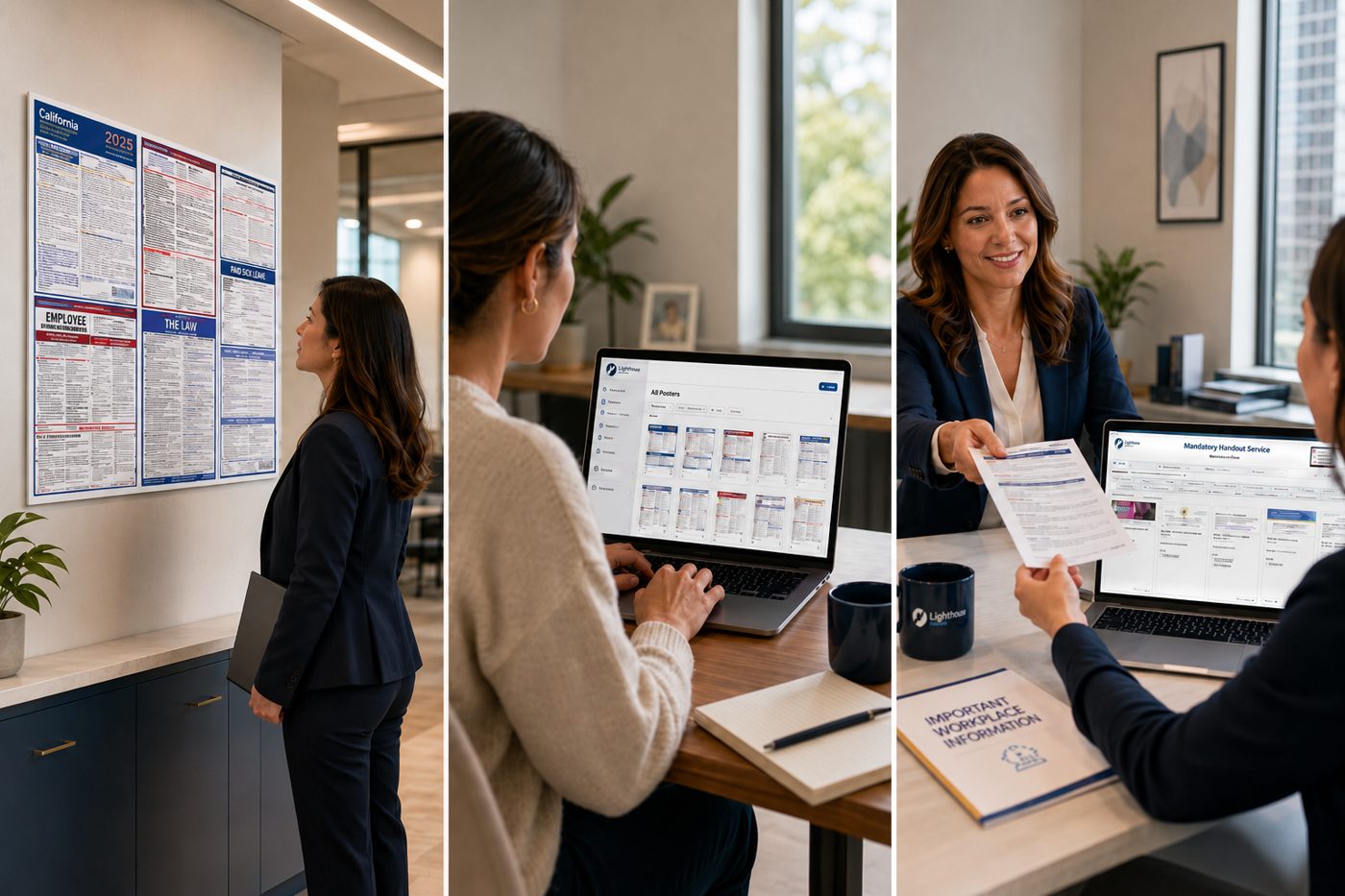
The Duty to Inform

Three scenes: an employee reading workplace posters, an employee viewing posters online, and an employer handing a notice to an employee

Campaign imagery for the positioning: posters at the worksite, digital access for remote employees, and handouts delivered directly to employees.

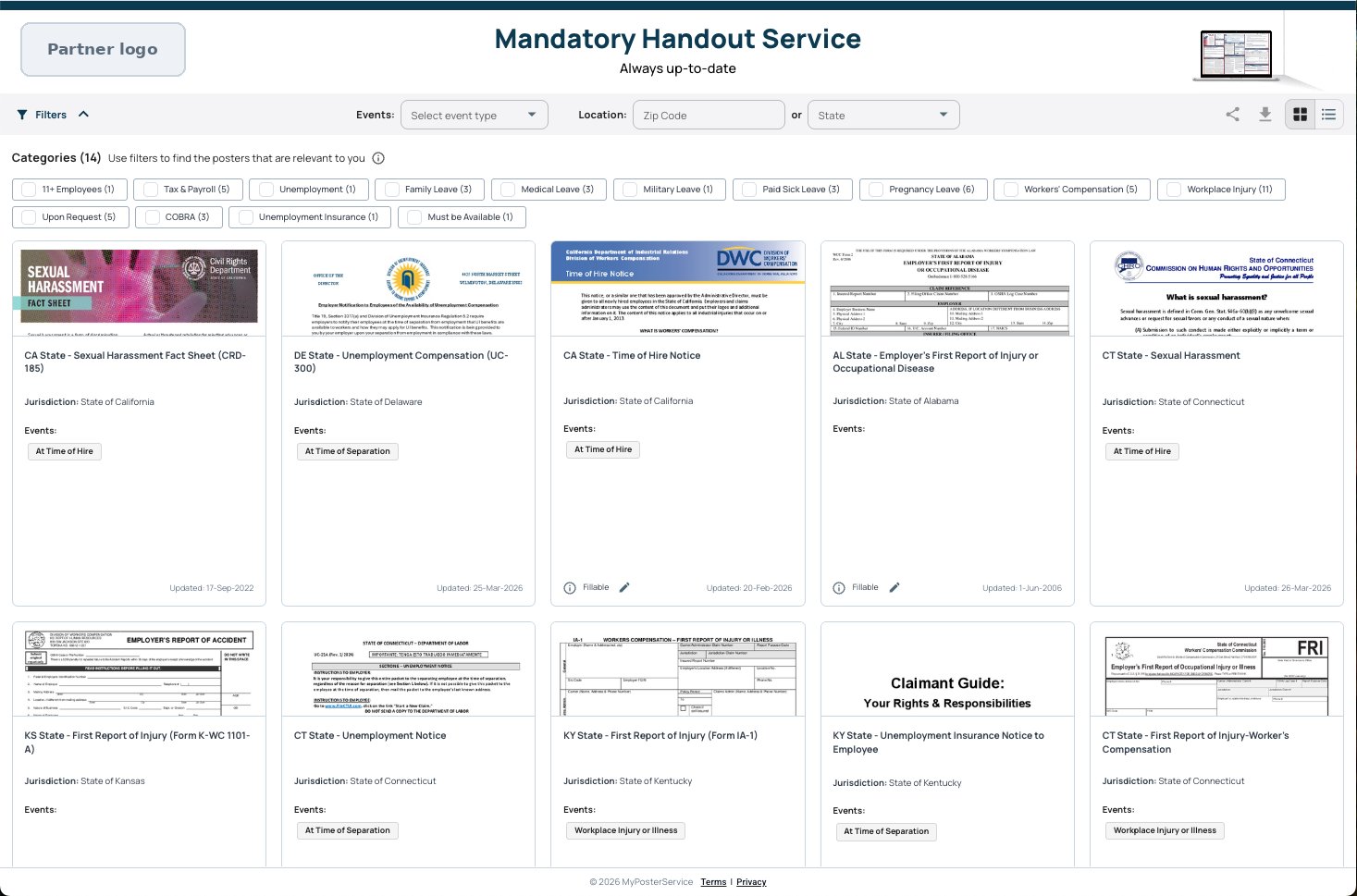
Find Employee Handouts

The handout library filtered by event and work location, with handout cards showing jurisdiction and triggering event

The handout library, themed with a partner's brand. Employers filter by event and work location, and each card shows the jurisdiction, the triggering event and whether it can be filled in.

⚖️ Key Trade-offs & Decisions

Decision Rationale
Every jurisdiction in one subscription, priced per client Breaks the per-state model, so partners can roll the service out to every client without asking where their employees work
Help employers find the likely handouts; the employer confirms The service cannot see every fact that changes the answer. Promising a determination would change the risk we carry and the trust we earn
AI interprets the question; rules decide the answer Smart Search maps plain language onto a fixed list of events. The existing results engine still decides which handouts appear, and location is never left to the model
No confidence scores; show what the AI understood instead A "high match" label implies assurance a compliance tool cannot give. An editable summary of the interpretation is honest and lets the employer correct it
An empty result never reads as "you're all set" No match can mean nothing is required, or that the situation has details the service cannot see. The screen says so
Saved packets are saved searches, not saved files When the library changes, every packet and shared link updates with it, so an employer never hands out an outdated version
Two versions: an anonymous partner link and a signed-in subscription The anonymous link deploys across a partner's whole client base with no per-client setup. The signed-in version adds saved packets, share history and fillable handouts, which only work when we know who the user is

📈 Results & Impact

🚀 Launched and Adopted

0 to 1 Live since June 2026

Took the service from concept to launch, and it has been in partner adoption since day one.

🤖 AI Added After Launch

Smart Search Shipped within months

Turned demo feedback into plain-language search and an annual schedule, shipped in quick iterations after V1.

🧩 A Product Line, Not a Product

3 of 3 Duty to inform covered

Completed the duty to inform, which lets sales lead with a bundle and offers existing poster partners an upgrade path.

💬 Reflection

The hardest part of this product was not the library. Anyone can host PDFs. The value is knowing what applies, and being honest about what the service cannot know.

The patterns we set here now shape the rest of the company's portfolio.

  • Sell intelligence, not a library: Positioning around applicability, not document count, is what separates a workflow from a folder.
  • Put AI in front of rules, not in place of them: A fixed list for the model, a visible interpretation and an honest empty state became the template for every AI feature PosterElite builds next.
  • Design for who the user is: Features like saving and history follow identity, not the price tier. Planning for that early saves rework in every service that follows.

Ready to see more of my work?

Explore other projects and business cases from my portfolio

Back to Portfolio